
If Bharatanatyam is a language, adavus are its alphabet. And just like handwriting, the quality is in the small details.
What is an adavu?
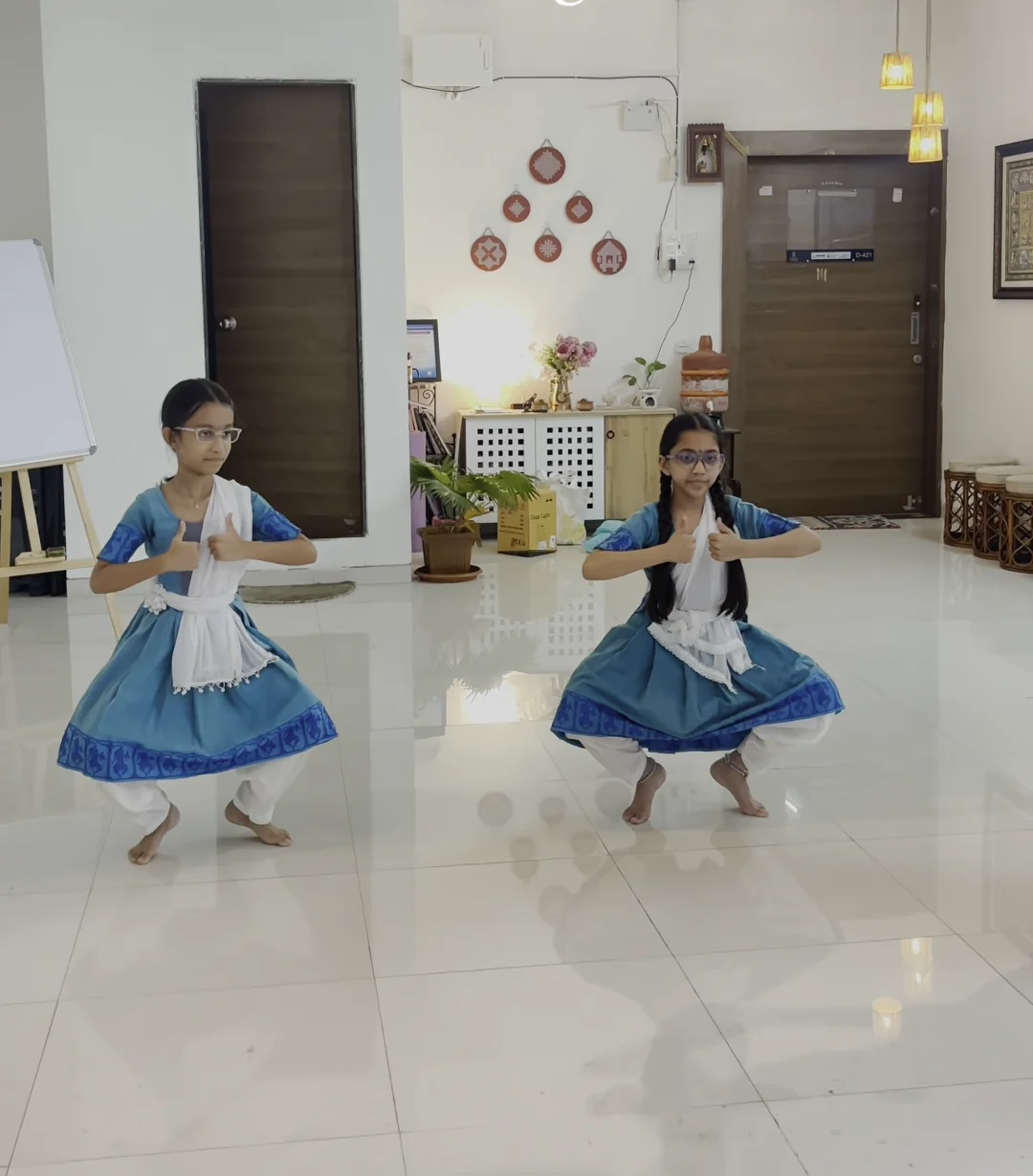
An adavu is a basic unit of movement in Bharatanatyam: a combination of a stance, footwork, hand gestures and eye movement, performed to rhythm. Adavus are grouped into families, such as tatta adavus (striking the feet) and natta adavus (stretching the leg), and each family has several variations.
Every dance item, from the simplest to the most complex, is built from adavus. That's why students spend so much time on them, and why advanced dancers keep returning to them.
The details that matter
The depth of araimandi
The half-seated stance gives Bharatanatyam its grounded, sculptural look. A few centimetres higher or lower changes the whole shape of the body, and the stance has to stay steady through the entire adavu.
The line of the arms
Arms extend from the shoulder in clean, straight lines. A dropped elbow or a bent wrist breaks the geometry that the Kalakshetra style is known for.
The shape of the hands
Each hasta (hand gesture) has an exact form. The difference between two hastas can be the position of a single finger.
Where the eyes go
A famous verse from the Abhinaya Darpana describes it simply:
Where the hand goes, the eyes follow. Where the eyes go, the mind follows. Where the mind goes, the feeling follows. And where the feeling is, there is rasa.
Even in a pure-rhythm adavu, the eyes give life to the movement.
Why we slow down
It's tempting to rush toward performance pieces. But an adavu repeated with care a thousand times becomes effortless and beautiful on stage. One repeated carelessly becomes a habit that has to be unlearned later.
At Indīvarā Arts we take the time to get the foundations right, because that is what lets a dancer grow freely later on.